

2026
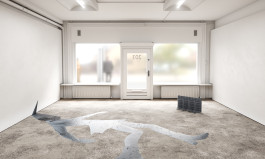
Solo exhibition at Espace Parallele, Paris.
Curation: Elisabetta Pagella
Production: Elena Castiglia
Photo: Ophélie Maurus
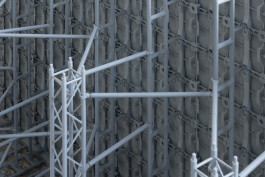
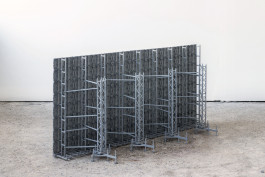
We are on a film set. The lights do not illuminate: they generate representation. Blue, green, and red lights flicker asynchronously. One can hear them operating, immediately understood not to be mechanical, but digital.
The scene begins.
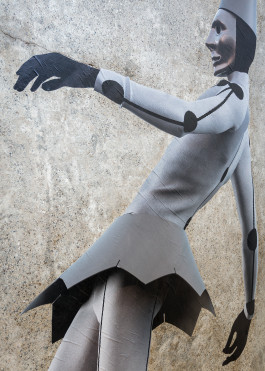
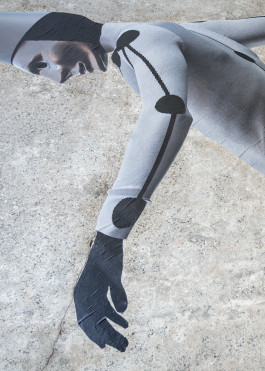
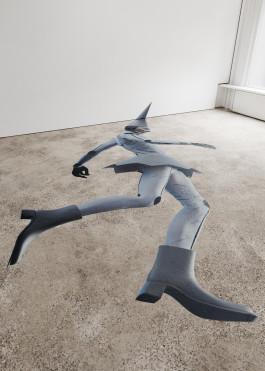
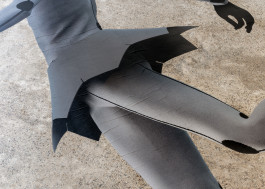
Cameras, cranes and tracking markers belong to the backstage of production. The medium, seemingly unveiled, ultimately reveals itself to be fictitious precisely within the tools designed for “special effects” as CGI, or Computer-Generated Imagery. Here, an androgynous figure dressed as a jester advances cautiously, as if crossing a minefield, destabilizing the perfect balance of illusion until exposing and collapsing it. An intentional short circuit in which the codes of simulation become visible and self-reflexive: the fiction of destruction itself. One cannot destroy what is already artificial. Or perhaps one can.
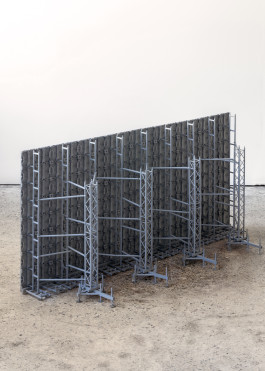
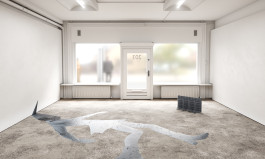
Valentin Gillet presents what we call fiction inside the Dream House, a virtual theater where the viewer finds themselves immersed, face to face with artifice. The spectator here walks across tracking markers used in cinema to create the green screen, the chromatic background capable of reproducing our presence in other contexts. A self-reflexive glitch emerges, in which the codes of simulation render themselves visible even if “illusion has not yet taken place”.
Imago est similitudo rei — the image is the likeness of the thing — yet today this is no longer sufficient, no longer entirely true or at least in constant renegotiation. The digital image has its own “sense of agency”, and does not merely imitate: it actively participates in the production of meaning.
When images supplant texts, we experience, perceive, and value the world and ourselves differently, no longer in a one-dimensional, linear, process oriented, historical way but rather in a two-dimensional way, as surface, context, scene. And our behavior changes: it is no longer dramatic but embedded in fields of relationships. What is currently happening is a mutation of our experiences, perceptions, values, and modes of behavior, a mutation of our being-in-the-world.
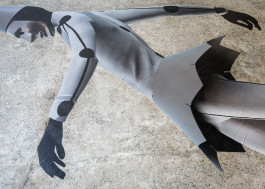
It is in this direction that Vilém Flusser develops the concept of “structural thinking,” here evoked through the reproduction of body parts: two eyes and a mouth. The work originates from found images, later fully reconstructed digitally using 3D and artificial intelligence. The issue is no longer what is being seen, nor the opposition between real and artificial, but rather the way in which the image produces meaning. Within this shift, a new “veil of Maya” takes shape: not metaphysical illusion, but technological representation, in which the image does not conceal reality but continuously reorganizes the conditions of visibility.
To this extent he images of facial elements completely stripped of of their expressive and communicative functions, the work exposes them not as neutral anatomical features, but as constructed interfaces of perception and meaning. Eyes and mouth function here as an aesthetic visual metaphor: deliberately deformed and rendered grotesque, they are intended to prompt reflection on their very raison d’être.
The mouth contains intraoral implants designed for dental prosthetics: it has lost its smile and its teeth. In the same way, the eyes have lost the possibility of being seen, but not of seeing. The grey surface replacing the cornea is a resin prosthesis for an artificial silicone body, used in cinema as a “practical special effect” (SFX), a techno-analog solution in the service of the digital. What emerges is a form of alienation, a true “perceptual disturbance.” In this context, the human is no longer a sole author but a co-author within a system of image production governed by technical and algorithmic apparatuses. The represented subject manifests within the image while simultaneously generating a “universal” image, capable of producing meaning beyond individual intentionality.
The aesthetic phenomenon of digital image production thus establishes a dialectical and contradictory relationship with reality, rooted in the very ontology of representation: the digital does not imitate the real, but actively contributes to redefining it, as Gillet argues. The digital translation of the world therefore becomes a possible articulation of experience and a new form of truth (?).
Elisabetta Pagella


2026
Solo exhibition at Espace Parallele, Paris.
Curation: Elisabetta Pagella
Production: Elena Castiglia
Photo: Ophélie Maurus
We are on a film set. The lights do not illuminate: they generate representation. Blue, green, and red lights flicker asynchronously. One can hear them operating, immediately understood not to be mechanical, but digital.
The scene begins.
Cameras, cranes and tracking markers belong to the backstage of production. The medium, seemingly unveiled, ultimately reveals itself to be fictitious precisely within the tools designed for “special effects” as CGI, or Computer-Generated Imagery. Here, an androgynous figure dressed as a jester advances cautiously, as if crossing a minefield, destabilizing the perfect balance of illusion until exposing and collapsing it. An intentional short circuit in which the codes of simulation become visible and self-reflexive: the fiction of destruction itself. One cannot destroy what is already artificial. Or perhaps one can.
Valentin Gillet presents what we call fiction inside the Dream House, a virtual theater where the viewer finds themselves immersed, face to face with artifice. The spectator here walks across tracking markers used in cinema to create the green screen, the chromatic background capable of reproducing our presence in other contexts. A self-reflexive glitch emerges, in which the codes of simulation render themselves visible even if “illusion has not yet taken place”.
Imago est similitudo rei — the image is the likeness of the thing — yet today this is no longer sufficient, no longer entirely true or at least in constant renegotiation. The digital image has its own “sense of agency”, and does not merely imitate: it actively participates in the production of meaning.
When images supplant texts, we experience, perceive, and value the world and ourselves differently, no longer in a one-dimensional, linear, process oriented, historical way but rather in a two-dimensional way, as surface, context, scene. And our behavior changes: it is no longer dramatic but embedded in fields of relationships. What is currently happening is a mutation of our experiences, perceptions, values, and modes of behavior, a mutation of our being-in-the-world.
It is in this direction that Vilém Flusser develops the concept of “structural thinking,” here evoked through the reproduction of body parts: two eyes and a mouth. The work originates from found images, later fully reconstructed digitally using 3D and artificial intelligence. The issue is no longer what is being seen, nor the opposition between real and artificial, but rather the way in which the image produces meaning. Within this shift, a new “veil of Maya” takes shape: not metaphysical illusion, but technological representation, in which the image does not conceal reality but continuously reorganizes the conditions of visibility.
To this extent he images of facial elements completely stripped of of their expressive and communicative functions, the work exposes them not as neutral anatomical features, but as constructed interfaces of perception and meaning. Eyes and mouth function here as an aesthetic visual metaphor: deliberately deformed and rendered grotesque, they are intended to prompt reflection on their very raison d’être.
The mouth contains intraoral implants designed for dental prosthetics: it has lost its smile and its teeth. In the same way, the eyes have lost the possibility of being seen, but not of seeing. The grey surface replacing the cornea is a resin prosthesis for an artificial silicone body, used in cinema as a “practical special effect” (SFX), a techno-analog solution in the service of the digital. What emerges is a form of alienation, a true “perceptual disturbance.” In this context, the human is no longer a sole author but a co-author within a system of image production governed by technical and algorithmic apparatuses. The represented subject manifests within the image while simultaneously generating a “universal” image, capable of producing meaning beyond individual intentionality.
The aesthetic phenomenon of digital image production thus establishes a dialectical and contradictory relationship with reality, rooted in the very ontology of representation: the digital does not imitate the real, but actively contributes to redefining it, as Gillet argues. The digital translation of the world therefore becomes a possible articulation of experience and a new form of truth (?).
Elisabetta Pagella
Top
© 2025
Top
© 2025